APR Vs Interest Rate: Learn Calculations Related to APR and Interest Rate and Tips to Reduce Your Loan Cost

Financial experts recommend APR to compare loans, as interest rates are not a reliable indicator of the overall cost. That’s why businesses and individuals often rely on payroll accounting services to evaluate loan-related expenses alongside salaries, benefits, and statutory deductions.
Additionally, you can uncover calculations related to APR and interest rate, real-time examples, and some financial tips to reduce your cost, along with the difference between interest rate and APR—especially when supported by accurate cash flow management services.
- APR Vs Interest Rate: What’s the Difference?
- What Is APR (Annual Percentage Rate)?
- How is APR Calculated?
- What Does Interest Rate Mean?
- How is the Interest Rate Calculated?
- Which Rate is More Preferred for Taking a Loan?
- What Factors Determine Your Interest Rate?
- How to Get a Loan with a Lower Interest Rate?
- Wrapping Up!
- Frequently Asked Questions
APR Vs Interest Rate: What’s the Difference?

The difference between APR and interest rate can help you assess the original cost of the loan accurately, particularly for new businesses that already depend on accounting services for startups to plan funding and financing decisions.
So, look at this breakdown table of APR vs interest rate.
| Features | Annual Percentage Rate (APR) | Interest Rate |
| Definition | It is the total yearly cost of a loan, which includes interest, fees, closing costs, and discount points | The percentage that a lender charges on borrowing money, i.e., principal. |
| Components | Interest rate + fees + points + mortgage insurance + other closing costs (if applicable). | Just the extra cost for using the lender’s money. |
| Purpose | Shows the overall and actual cost of the loan because it includes the interest rate, fees, and other mandatory charges. | It determines your base monthly payment of a loan as a percentage, including principal and loan term. |
| Usefulness in comparing loans | Important for comparing different loan options, as it calculates the total additional cost. | Less useful for comparing loan offers because it doesn’t include fees, origination charges, etc. |
| Typical Value | Higher than or equal to the interest rate. (never lower) | Lower than the APR. |
| Type of rate | Both, fixed and variable | Both, fixed and variable |
What is APR (Annual Percentage Rate)?
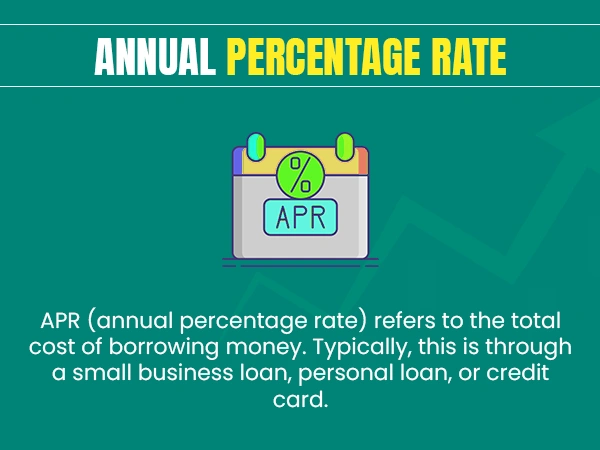
Annual Percentage Rate (APR) is the yearly cost of borrowing money with credit cards or installment loans like mortgages, personal loans, and auto loans. Businesses often evaluate APR carefully when working with bookkeeping services to ensure financing costs are recorded accurately.
This method includes interest rates, origination fees, discount points, and other mandatory charges. It gives a more detailed picture of the overall loan’s expense or fixed cost, which becomes especially important during year-end accounts services and financial reporting.
Tip: APR can help you better understand the total fixed cost of a loan, allowing you to compare the best offers and find the cheaper option while maintaining effective cash flow management services.
Also Read: Tax Attorney: Roles, Salary, Expertise, and How to Become One
How is APR Calculated?
The formula for calculating an annual percentage rate:
APR = {[(Total interest + Fees) / Principal] / Number of days in loan term} x 365 x 100
Key factors influencing your APR calculation:
- Total interest: The base cost to borrow money.
- Fees: Lender fees, origination charges, points, or other finance charges.
- Principal: The original amount of money borrowed.
- Loan Term: The length of the loan (e.g., 1 year)
Let’s understand with a real-time example:
Mr. Brownie borrowed a $2,000 loan for 180 days, with an interest rate of 6% ($120) and $50 in fees. So, what’s the APR?
Step 1: Add the total interest and fees.
$120 + $50 = $170
Step 2: Divide the sum by the original loan amount (principal).
$170/$2,000 = 0.085
Step 3: Now, divide the result by the length of the loan term.
0.085/180 = 0.00047222
Step 4: Multiply the result by 365 to get the annual rate.
0.00047222 x 365 = 0.1723611
Step 5: Multiply by 100 to express it as a percentage.
0.1723611 x 100 = 17.24% (APR)
What Does Interest Rate Mean?
The interest rate is the percentage charged for the loan, indicating the cost of borrowing money from someone else over time.
Factors like inflation, economic conditions, and the lender you work with primarily impact your interest rate. Remember, higher rates mean higher costs for borrowers.
However, your credit history and credit score also influence your interest rate. If you have a higher credit score and a positive payment history, you will be eligible to unlock loan options with lower interest rates.
How is the Interest Rate Calculated?
To calculate a loan’s interest, you should use this formula:
I = P × R × T
- P (Principal) – The original amount of the loan.
- R (Rate) – Annual interest rate as a decimal.
- T (Time) – the length of the loan term.
Key factors influencing your interest rates:
- Credit Score or History: A higher credit score means lower rates.
- Loan Term: Longer terms usually mean higher interest paid.
- Collateral: Secured loans like auto loans and receivables financing have a lower rate.
Let’s understand with a real-time example:
Mr. John borrowed a loan of $50,000 to start his business for 3 years, with an interest rate of 5%. Now, calculate the amount he has to pay extra for borrowing money.
P – $50,000
R – 5% or 0.05
T – 3 years
I = P × R × T
I = $50,000 × 0.05 × 3
= $7,500 (extra payment for borrowing money)
After acquiring knowledge on APR vs interest rate, which means the difference between APR and interest rate calculation methods, you are all set to discover which rate truly identifies the loan amount in the next section.
Also Read: What Is Tax Exempt? Meaning, Benefits & How to Become Exempt
Which Rate is More Preferred for Taking a Loan?
In APR vs interest rate, when taking a loan, the APR (Annual Percentage Rate) is more important for a true apples-to-apples comparison.
It includes the interest rates, discount points, fees, and other mandatory charges, which help you to understand the cost of your loan. Moreover, you can use APR to compare other loan offers quite substantially to find the cheaper one that suits your financial conditions.
While the interest rate is the key to budgeting monthly payments for loan repayment, it allows you to lower upfront costs for shorter terms and plan your cash flow statement efficiently.
That’s the difference between interest rate and APR in terms of getting and comparing loan offers.
What Factors Determine Your Interest Rate?
The major factors, such as credit score, market trends, type of rate, loan term, and down payment, determine your interest rate.
Let’s understand these factors here for in-depth guidance.
1. Credit Score
Lenders or financial institutions prioritize your credit score to lend you money or a loan. Therefore, the high score reflects low-risk behavior, indicating that you are capable of paying and managing loans on time.
2. Market Trends
Economic indicators like inflation, financial growth, and the policies of the Federal Reserve System affect the interest rate. For example, if inflation increases, the lender will charge higher rates to meet future purchasing power, and vice versa in low inflation.
3. Type of Rate
Some banks offer a choice between fixed-rate loans and variable-rate loans. The fixed one remains the same during the loan term, no matter the country’s policies or inflation. Variable interest rates may go up and down with market fluctuations.
4. Loan Term
Long-term loans tend to have a high interest rate, as you are using the lender’s money for a long time. On the other hand, short-term loans are likely to have lower rates.
5. Down Payment
If you take out a mortgage loan, the size of your down payment will influence your interest rate. However, if you are opting for a student loan, the finance provider will consider your payment history, employment, and debt financing first.
How to Get a Loan with a Lower Interest Rate?
You should pay your credit and debit debts, consider a credit mix, opt for a short-term loan, and compare different loan options to lower your interest rates.
Here are these tips to negotiate the cost of a loan in great detail.
1. Pay Your Credit and Debit Debts
If you have other outstanding credit and debit debts, try to pay them as soon as possible, indicating low risk. The lower your debt-to-income (DTI) ratio, the better your score is.
2. Consider a Credit Mix
Consider a credit mix by taking other types of credit accounts, including credit cards, mortgages, or auto loans. It signifies that you can handle various debts responsibly at once.
3. Opt for a Short-Term Loan
Short loan durations usually come with lower interest rates because lenders face lower risk and recover their money faster than with long-term loans.
4. Compare Different Loan Options
According to the Consumer Financial Protection Bureau (CFPB), the best way to reduce your cost is to shop around and compare rates between different lenders. It is important to note that you should compare loan options based on APRs, not interest rates.
Also Read: What is Form 8962? Who Must File It and How to Fill Out Form 8962 (A Complete Guide)
Wrapping Up!
Understanding the difference between APR and interest rate will help you to calculate your overall cost of a loan, manage financial debts, and find the best and cheapest offers for you.
Moreover, APR vs interest rate clears the air about the misinterpretation that both terms are the same and solves the query, “Is APR the same as interest rate?”
Frequently Asked Questions
Ans: The interest rate is the basic cost of borrowed money, while the APR is the total yearly cost, including the interest and fees.
Your monthly payment is based on the interest rate, and the APR shows the total expense of a loan.
Ans: APR is much higher than the interest rate because it measures the principal amount, interest, fees, and other charges to show the total cost of a loan. While the interest rate only covers the principal, it is usually lower than the APR.
Ans: A 7% APR means the annual cost of borrowing money is 7% of the principal amount. However, it also includes the interest rate and additional fees.
Ans: With an 800 credit score, you can qualify for the best offers, ranging from credit cards below 15%. It indicates that you are eligible for the lower interest rates.
Sources: