3 Financial Metrics Businesses Must Track During Rebranding Efforts


Your business cannot survive in these trying times without potent branding. Branding is the face you show to the world in order to attract customers. If your original branding fails to attract many eyes, it’s better to rebrand yourself.
And in the lifecycle of almost every business, there comes a point to rebrand itself. Yes, even the big, successfully running ones. Remember Dunkin’ Donuts becoming just Dunkin’. The reasons can be numerous, such as a new business path strategy or a merger.
And, it’s not just about revamping your website and marketing campaigns with a new motto. Sometimes, even physical, tangible assets of your business need to be changed. For example, a successfully running hospitality chain can partner with a hotel renovation company to refresh its vibe, aiming to attract new consumers.
But after the rebranding, how do you know if this was the right decision? Are you going in the right direction? Should you just take a U-turn? Do you know that up to 40% of rebrands don’t lead to positive ROI (Source)?
In this article, I’ll answer all of these questions by listing just three financial metrics that you have to monitor after your rebranding so as to have some sort of certainty or assessment of your decision.
KEY TAKEAWAYS
- If your business has gone dull or you just crave more growth, rebranding it might be a good decision.
- But it’s also a very risky decision, as many of the rebrandings take your capital but don’t lead to any substantial profit; they can even make things worse.
- Assess your rebranding campaign by monitoring three financial metrics: Customer acquisition rate, Brand perception, and Operational health.
1. Customer Acquisition Cost
The rebranding objectives can be numerous, but attracting more customers remains in there. A successful rebranding should find you new customers and appeal to existing ones more easily. Afterwards, you should need to rely less on paid advertising channels.
For example, in the hospitality industry, drawing customers is heavily dependent on brand image. A 2024 McKinsey report shows that travelers don’t enjoy one-size-fits-all experiences but reward individual personalization. Therefore, brands may need to work on perception among their target customer segments, say, luxury seekers versus budget watchers.
According to Amerail Systems, hotels can benefit from minimal guest disruption during brand conversions or other redevelopment. An organization’s dedication to keeping customers satisfied may also affect their likelihood of returning, thereby reducing the need for investment in acquisition.
Comparing the customer acquisition costs (before and after these initiatives) can give you a handle on their success. Accordingly, you can take steps for course correction, such as ensuring your new brand identity does not get lost on social media due to ineffective collaborations.
How to track:
- Measure all the costs involved in customer acquisition, including the salaries of employees and investment in new digital tools.
- Divide it by the customers you have gained in the required period.
- Compare the costs with the pre-rebranding figures to understand the cost-effectiveness of your strategic moves.
2. Brand Perception
Rebranding generally aims to make more people aware of the brand, and that too in a positive way. Some of them aim to change the sentiment that a brand evokes. The associations that come to mind when customers think of the specific company may not be doing the revenue streams any favors.
Brand perception sits at the intersection of three major aspects of your brand: Reach, Awareness, and Sentiment.
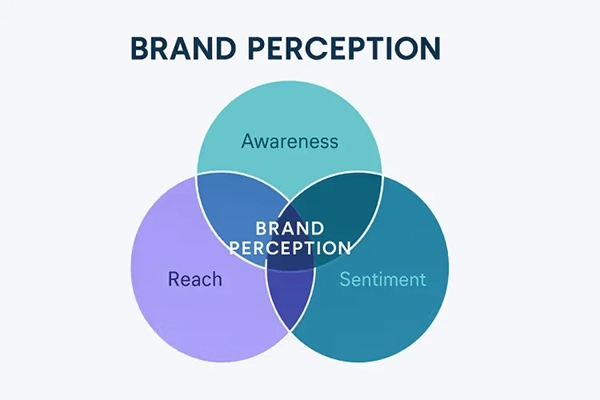
This makes brand perception an important metric to track during a rebranding exercise. Many industry reports find that positive brand perception can uplift revenue. Harvard Business Review notes that profitability no longer has a one-to-one relationship with your market share, as consumers have moved on to using many other metrics in forming quality perceptions.
Net Promoter Score and the likelihood of customers recommending the business have been used for this purpose for a long time. However, it has now become ambiguous, with some marketers feeling that classifying clients into promoters, passives, and detractors is an oversimplification. Instead, measuring the customer satisfaction score may be a more balanced approach.
How to track:
- Perception audits
- Sentiment analysis using listening tools for social media and other channels
3. Operational Health
Focusing on how the world sees you is good, but you shouldn’t forget about maintaining your operations efficiently in all this. Rebranding exercises can be expensive, making them financially unviable for small and medium enterprises.
An inability to track liquidity adequately can place the organization in trouble when day-to-day demands, such as wages and property expenses, come calling.
Fortunately, AI has entered this scene as a blessing for businesses that wish to create value and be heard but cannot afford to spend too much on marketing communication. A recent PwC report on the benefits of AI adoption highlights that 20 to 50% of firms have seen reduced costs for media through smarter spending efficiency. Around 10 to 30% have witnessed more consumer relevance.
As your business explores these developments to build a stronger brand identity, keep an eye on the expense sheet.
How to track:
- Measure revenue growth in light of rebranding expenditure.
- Assess cash flow comfort.
- Watch out for process inefficiencies that may highlight cost-based obstacles.
Now you know all three major financial metrics that you have to track whenever you rebrand. Brand perception helps monitor business as usual. They ensure that your company is growing and developing a rapport with the audience, not just keeping its head above water in the everyday chaos.
The exponential rate of adoption of AI-driven tools has made measuring these metrics much easier. Even so, partnering with trusted professionals can ensure accurate tracking that aligns with your specific business area. After all, intuition and foresight also become sharper with diverse experiences.