Bridging the Gap Between Gig Economy Workers and Traditional Benefits

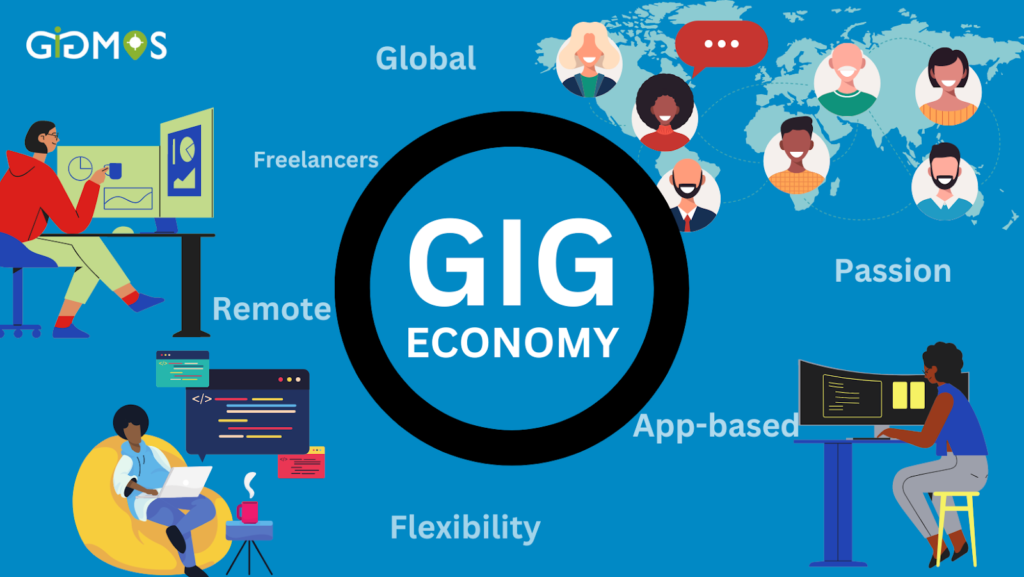
Do you feel a great gap between the gig economy workers and traditional benefits, and are you wondering how to bridge it? The answer is here.
According to Business Research Insights, the global gig economy is estimated to be worth $674.13 billion in 2026. It is expected to rise at a CAGR of 15.79% from 2026 to 2035. This would be worth around $2,522.37 billion at the end of the forecast period.
Therefore, this article aims to understand the gig economy, analyse its components, and discuss how it goes beyond the traditional working patterns and more!
Key Takeaways
- Studying the benefits divide in Modern Workforces
- Health coverage challenges for Independent professionals
- Financial Stability beyond health insurance
- Policy Conversations and the future of work
The Benefits Divide in Modern Workforces
The gig economy faces a great benefits divide from the traditional employment structured benefits, as it is a rapidly growing market with a different notion nd work culture.
Digital platforms have a great role to play in this expansion, where they act as chains to connect independent workers with contractual jobs, short-term contracts, flexibility, and income opportunities simultaneously.
Some of the key benefits that gig workers are excluded from include :
- Access to stable wages
- Benefits and social protection of a full-time job
- Income security and worker satisfaction
- Financial stability and other incentives
- Contact roles often encounter inconsistent periods of work
Fun Fact: According to McKinsey, around 20-30% of working age population is engaged in independent work.
Health Coverage Challenges for Independent Professionals
Healthcare remains the most immediate concern for many gig workers.
On one hand, most traditional workers have health insurance covered by their employers, such as COBRA coverage, to avoid sudden lapses when changing jobs or being fired from a firm.
There are also strategies available to reduce COBRA insurance coverage expenses. For instance, one can compare marketplace plans, use health savings accounts strategically, select essential benefits only, time enrollment, etc., to save money.
On the other hand, gig workers don’t have employer-sponsored plans. This puts them in a situation where they have to navigate private insurance markets themselves, which can feel confusing and expensive.
Premium costs, limited provider networks, and complex enrollment timelines often discourage consistent coverage.
In short, only 40% of the gig workers have access to health insurance, whereas the access to healthcare for full -time employees ranges upto 82%, which summarises the vast gap between the workers.
Financial Stability Beyond Health Insurance
Apart from medical benefits, other important benefits for a worker include:
- Retirement planning
- Disability protection
- And emergency savings
Which again seems to be at a far edge for gig workers.
Full-time employees often rely on automatic payroll deductions and employer contributions to support these goals. Gig workers must build these systems independently, often without consistent income streams.
The other excluded benefits include :
- Retirement benefits
- Pension plans
- Inconsistent Social Security
Gig work’s flexibility allows people to adjust hours and take on extra work to save more.
However, they encounter challenges such as:
- Income volatility,
- a lack of structured savings mechanisms
- and limited access to retirement
This gap has led to the promotion of financial tools tailored to freelancers and contractors.
As a result, Digital platforms now offer :
- Simplified retirement accounts
- Income smoothing tools
- Insurance products designed for variable earnings.
These options became widely accepted because they provided more flexibility, the responsibility shifted to workers rather than employers, and changed the traditional worker-employer relationships.
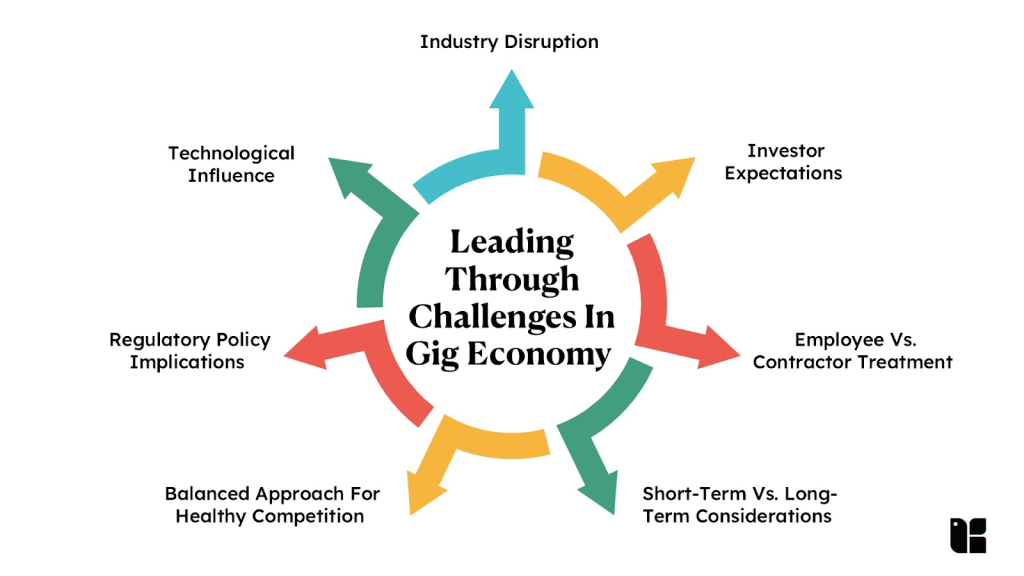
The other challenges of the gig economy can be seen in the infographics :
Policy Conversations and the Future of Work
Policy conversations by government and industry specialists hereby form the coreof future of the gig economy.
The primary problem that comes across in such situations is encouraging innovation while simultaneously reducing the gaps in worker security.
This leads to diversion of policies in different ways, where some focus on creating basic benefits for all the workers, whereas others focus on the company’s role in enhancing worker benefits and ensuring the provision of necessary incentives.
Another idea that determines policy formulation is recognising the need for worker mobility. With diversity in job roles and increased switch from full-time roles, to contractual, to freelancing, to remote work, to hybrid settings .
The need to change the eligibility criteria as per changing career shifts becomes important.
Other discussions also involve :
- Including portable benefits
- Tax incentives
- Health coverage
The outcome of these debates will shape how future workforces are structured. As more people choose flexibility over permanence, benefit systems will need to adapt to support mobility rather than stability alone.
Conclusion
The gig economy forms an important part of the changing workforce. With a change in careers and evolving work culture, adopting asper the economy has become the need of the hour.
Bridging the gap between gig economy workers and traditional benefits has thus turned into an important step which needs to be addressed as early as possible because the proportion of workers in this economy is increasing with a progressive workculture.
Ans: Gig economies are different from the regular ones; workers are paid on the basis of the regular figures they perform.
Ans: Freelancers gain the maximum benefits from the gig economy.
Ans: Gig workers often face a lack of job security
Ans: The average percentage of people who are gig workers ranges between 25 and 47 per cent.