How to Manage Prepaid Expenses and Accruals


“Revenue is vanity, profit is sanity, but cash is king.” — Alan Miltz (Financial Strategist)
Yet even cash can mislead if it’s not recorded in the right period. That’s where these timing adjustments quietly do the heavy lifting. They ensure your financials reflect reality, not just timing. Handled well, they bring clarity. Ignored, they distort everything, be it profitability or decision-making.
In this guide, learn how to manage advance payments and accrued costs effectively with practical steps, examples, and tips to improve financial accuracy and reporting.
Understanding Prepaid Expenses and Accruals
At first glance, these accounting adjustments seem just technical. But actually, these timing tools shape the perceived business performance.
Prepaid expenses are payments made in advance for goods or services that will be consumed in the future. Examples include insurance, rent, and software subscriptions. These are initially recorded as assets and expensed gradually as the benefit is realized.
Accruals, on the other hand, represent expenses incurred but not yet paid. These include wages, utilities, and professional services. Accrued expenses are recorded as liabilities until payment is made.
The distinction between these two categories is critical. Prepayments defer expense recognition, while accruals accelerate it to match the period in which the obligation arises.
Recording and Amortizing Prepaid Expenses
Paying upfront is easy. Spreading that cost correctly over time is where discipline comes in.
Hence, prepaid expenses must be allocated across periods in such a manner that they benefit you. This process, known as amortization, ensures that expenses are recognized gradually rather than all at once.
For example, a one-year insurance payment should be divided into monthly expense entries. Each period reflects only the portion of the service consumed.
Key steps include:
- Recording the initial payment as a prepaid asset
- Establishing an amortization schedule
- Posting periodic expense entries to reduce the asset balance
This structured approach maintains accuracy and prevents overstatement of expenses in a single period.
Managing Accrued Expenses Accurately
Expenses don’t wait for invoices. That’s why accruals exist.
Accrued expenses need to be recorded even if cash transactions have yet to occur. This ensures that financial statements reflect obligations that have already been incurred.
Accruals must be estimated based on available data, such as contracts, usage metrics, or historical patterns. Once the actual invoice is received, adjustments may be required.
Accurate accrual management involves:
- Identifying all incurred but unpaid expenses
- Estimating amounts using reliable data sources
- Reversing or adjusting entries when payments are recorded
Timely recognition reflects actual liabilities.
Aligning with the Matching Principle
Here’s the core idea tying everything together: expenses should match the revenue they help generate.
Failure to align expenses correctly results in distorted financial performance. It can mislead stakeholders and decision-making.
Proper alignment requires consistent application of accounting policies and regular review of entries.
Automating Processes for Accuracy and Efficiency
Manual tracking works… until transaction volume increases. Errors in schedules, missed entries, and inconsistent calculations are common issues.
The following infographic lists the tasks in the process of recording these entries:
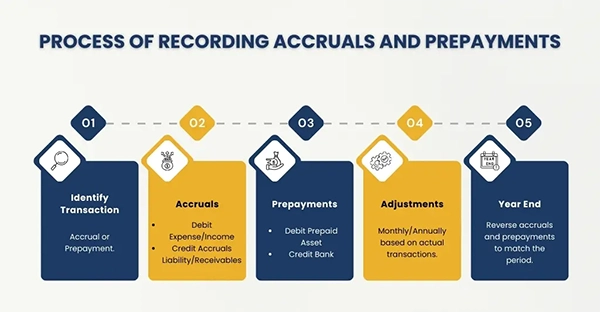
Using systems such as accrued expense automation standardizes calculations and ensures consistent application of rules. As a result, accuracy is improved. These systems generate schedules, automate journal entries, and provide real-time visibility into balances.
Automation reduces:
- Manual calculation errors
- Time required for financial close
- Inconsistent reporting risk
Technology ensures scalability and reliability.
Handling Adjustments and Reconciliations
Even with solid systems, numbers need regular reality checks.
Regular reconciliation is necessary to ensure that prepaid balances and accrued balances remain accurate. This involves comparing recorded amounts with actual usage or invoices.
Adjustments may be required when estimates differ from actual values. These adjustments must be recorded promptly to maintain accuracy.
Reconciliation processes include:
- Reviewing schedules against supporting documentation
- Identifying discrepancies between actual and expected numbers
- Posting corrective entries as needed
Consistent reconciliation prevents the accumulation of errors.
Integrating Prepaids and Accruals into Financial Systems
Disconnected data is a silent problem.
Prepayment-related data and accrual data must be integrated into broader financial systems. This ensures that all entries are reflected in financial statements and reports.
Integration allows:
- Automatic updates to general ledger accounts
- Consistent reporting across departments
- Reduced duplication of data entry
Connected systems improve efficiency and reduce inconsistencies.
Monitoring Financial Impact and Reporting
Prepaids and accruals directly impact your profitability and liabilities.
Regular monitoring ensures that these elements are accurately reflected in reports. This supports better forecasting and decision-making.
Financial visibility depends on accurate and timely recognition of both advance payments and outstanding obligations.
Documentation and Audit Readiness
If it’s not documented, it didn’t happen from the audit perspective. So, businesses must maintain all prepayment-related and accrual entries.
This includes contracts, invoices, schedules, and calculation methods. Clear documentation ensures transparency and simplifies audit processes.
Structured records reduce risk and improve confidence in financial reporting.
Conclusion
Managing prepaid expenses and accruals is about telling the accounting truth with your numbers. It requires precision, consistency, and integration with financial systems.
By applying structured processes, leveraging automation, and maintaining accurate documentation, businesses can ensure compliance and reliable reporting. Proper management of these accounting elements supports accurate financial statements and strengthens overall financial control.