The Hidden Cost Your Books Are Not Showing: Employee Turnover


Have you ever wondered whether your books might not be showing the actual figures, and there might be some hidden costs? If yes, the answer is here.
According to Hubstaff, the average turnover rate for any industry is less than 20%, and voluntary attrition averages about 13%.
Therefore, this article aims to discuss the hidden costs that books often tend to ignore, which is employee turnover.
From the idea where money actually goes to a problem associated with the system and not people, and more!
Key Takeaways
- Where the money actually goes
- The pattern that matters the most
- A system problem, not a people problem
- What it comes down to
Where the Money Actually Goes
Recruitment advertising, agency fees, and interview time are the obvious expenses. But they represent only a fraction of the true cost that is borne by businesses.
So, you can see the productivity lossclearly in such situations. A departing employee typically operates at reduced capacity during their notice period.
And even their replacement needs three to six months to reach full productivity.
During that ramp-up time, other team members carry extra workload, often requiring overtime or delaying other projects, which is ultimately a productivity loss.
Moreover, the knowledge that is left with each departure.
Customer relationships, process understanding, and institutional memory are all held on standpoint.
None of this appears on a balance sheet, but rebuilding it takes time and money, which are essential resources.
Training costs add up as well. Formal training programmes, informal mentoring, and the mistakes that inevitably happen while someone learns the role.
Every new hire repeats this cycle from the beginning, indicating the loss of productive time and money.
Fun Fact
In Japan, the average working week is 60-70 hours. Many Japanese people drop dead at work as a result. This is known as ‘Karoshi’. Every year, over 10,000 Japanese suffer from ‘Karoshi.’
The Pattern That Matters Most
Research from Brandon Hall Group reveals something that should concern every business owner.
Organisations with a structured onboarding programme achieve 82% better employee retention and over 70% improvement in new hire productivity, which can be proven beneficial for business groups.
The connection is direct. Employees who experience poor onboarding are twice as likely to seek new opportunities within their first year.
They arrive with enthusiasm. When reality fails to match expectations, the countdown to departure begins.
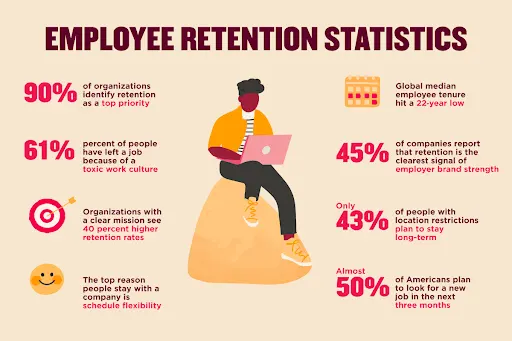
The infographics further depict the statistics of employee retention :
This is not about bad hires. Many employees who leave early had the skills and motivation to succeed.
Something in those first weeks convinced them to look elsewhere, which discourages the employees.
A System Problem, Not a People Problem
For small businesses, the challenge is structural. The owner or manager responsible for onboarding is usually the same person handling sales, operations, and a dozen other priorities.
New employees get attention when time allows, which is rarely enough.
What works informally with five employees breaks down at fifteen. The founder, who personally trained everyone, cannot maintain that approach as the team grows.
This is where automation becomes valuable.
HR tools like FirstHR handle the administrative side of onboarding automatically, so welcome communications, document collection, and training checklists happen consistently across every hire without requiring constant oversight from already-stretched managers.
This practise allows a well-functioning system and solves the problem of hiring and re-hiring.
What It Comes Down To
Employee turnover is a financial leak that most businesses fail to measure accurately, as it is not a visible component in the books.
The costs are real even when they do not appear as distinct line items in your accounts.
Investing in proper onboarding is not an expense. It is a return on the investment you have already made in recruitment, training, and development, so fetching the best talent becomes viable.
The businesses that understand this build stable teams while their competitors keep funding a revolving door.
Ans: Employee turnover can cost organisations millions every year. Turnover rates outside industry norms can signal major problems with culture, managers, compensation, and benefits, and negatively impact customers.
Ans: There are two types of employee turnover. These are : Voluntary Employee Turnover: This occurs when employees leave on their own, often due to job dissatisfaction, better offers, or personal life changes. Involuntary Turnover: This happens when employees are terminated due to poor performance, misconduct, or company downsizing.
Ans: The employee turnover rate can be calculated through the formula: Turnover Rate = (Number of Employees Who Left ÷ Average Number of Employees) × 100
Ans: High turnover leads to increased recruitment costs, productivity loss, and low morale among remaining employees. It also affects organisational stability.