Understanding Debt Relief: Options Available to Struggling Small Businesses


“Debt is like any other trap, easy enough to get into, but hard enough to get out of.”
– Henry Wheeler Shaw (Humorist)
Dues have always been like this. But at the moment, this statement might be most intensely relevant.
You took on debt at high interest rates of the past, thinking it would be a cakewalk to reimburse. On top of it, the AI recession is also denting your bottom line. Institutions are keeping the cash flow to themselves, no lending.
Big businesses still command capital to deal with the situation, but it’s the small ones that are struggling the most.
Now, what can you do about those overwhelming liabilities? I am here to answer that question.
In this article, I’ll answer why so many small businesses are in a debt trap, how you can get relief, what the most common ways are to achieve that, and how to choose the best one for you.
KEY TAKEAWAYS
SMBs are dealing with high debts right now.Some due settlement options are: negotiation, consolidation, bankruptcy chapter 7, 11, and 13.Choose the best way out of the debt based on your specific situation.
What Is Debt Relief for Small Businesses?
Debt relief is a blanket term. It just means a way to alleviate the liability pain of a borrower.
Whether that’s renegotiating debt terms, consolidating loans, or filing for insolvency.
Basically, due resolution “relieves” a business of its responsibility to repay the debt in its current form.
Bankruptcy is the most well-known form of liability relief, but it’s certainly not the only option.
Different types of insolvency affect credit in different ways. But before even thinking about bankruptcy, there are other types of debt settlements available.
Choosing the wrong option can not only affect credit, it can harm a business. Time is something SMBs can’t afford to lose.
Here are the primary due resolution options:
- Negotiation
- Consolidation
- Bankruptcy (Chapter 7, Chapter 11, Chapter 13 Bankruptcy)
Each option has its pros and cons. Some businesses will qualify for certain options, and some won’t.
It’s important to understand each option, why it’s a fit (or not), and what the long-term consequences will be.
Why Are Small Businesses Searching For Debt Relief?
Why are businesses affected the most? It’s in the stats.
Business insolvency filings are up 24% from this time last year.
Specifically targeting SMBs, Subchapter V elections have increased 61% in the first half of 2024.
Small entrepreneurs are feeling the squeeze as interest rates and operational costs rise, while consumer spending and affordable credit access weaken.
Businesses that were barely hanging on before the interest rate hikes don’t have much room for error. Which means more businesses need to know about debt settlement programs before it’s too late.
What Debt Relief Options Do Small Businesses Have?
Though there are many ways to manage your liabilities, I’ve curated the most common and effective ones for you:
Negotiation
The oldest trick in the book.
For debt negotiation, creditors are contacted directly, and an attempt is made to negotiate the loan. The goal is to negotiate a lower payoff amount, lower interest rate, or more favorable repayment terms… without filing for bankruptcy.
It’s an informal approach and can work well to preserve relationships with creditors. Flaw? Creditors aren’t obligated to negotiate, and there’s no legal protection from collection activities during negotiations.
Consolidation
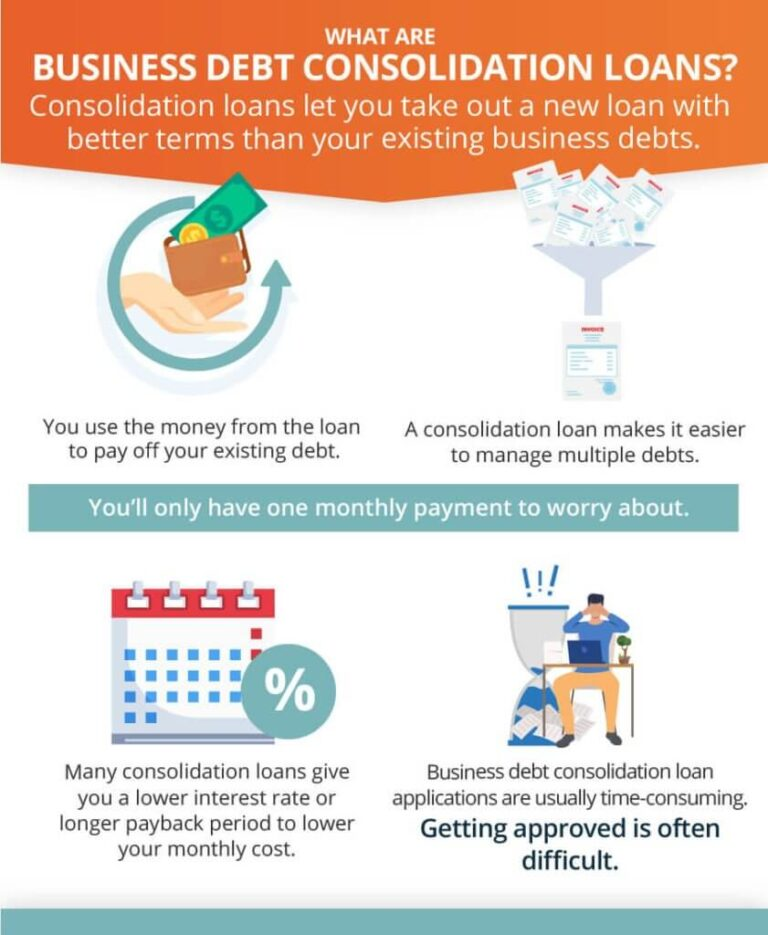
Consolidation is when multiple debts are combined into one debt. One monthly payment goes to the consolidation loan’s lender instead of several payments to multiple creditors.
A consolidation loan won’t reduce what is owed. But it can make debt more manageable and prevent individual collection actions from hitting all at once.
The following infographic explains consolidation in very simple and accessible terms:
Chapter 7 Bankruptcy
This is a liquidation insolvency.
A trustee will be appointed to sell business assets and use the funds to pay back creditors. Once the sale process is complete, many debts will be discharged.
Worth repeating…
There is no coming back from a Chapter 7 bankruptcy. The business will cease operations entirely. You can start over from square one if you have some energy and courage left.
Chapter 13 Bankruptcy
Chapter 13 bankruptcy is intended for sole proprietors and self-employed business owners.
Instead of shutting down operations and discharging debts, eligible owners can repay debts over time. Typically between 3-5 years.
One of the biggest benefits of Chapter 13 is the automatic stay. As soon as the petition is filed, creditors must stop all collection actions: lawsuits, garnishments, calls, everything.
A business must be a sole proprietorship to file for Chapter 13 bankruptcy. Corporations and LLCs are not eligible.
Chapter 11 Bankruptcy
Chapter 11 bankruptcy is meant for small business owners who have LLCs or Corporations.
Subchapter V is a subset of Chapter 11. This makes the process easier for small businesses by streamlining the process, reducing costs and complexity. But not all businesses qualify for this one.
Only businesses with debt less than $7.5 million qualify. Earlier, the limit was even lower: $3.025 million.
Filing for Chapter 11 allows a business to continue operating while a repayment plan is crafted to keep it alive.
How Do You Know Which Option To Choose?
Of course, you won’t commit to all of the above at the same time. Every single strategy would have a different impact based on your specific case.
What works for one business may not be the best option for another. Things to consider include:
- Business structure (sole proprietor, LLC, Corporation?)
- Total dues load.
- Whether the business is fundamentally capable of surviving?
- How quickly a solution is needed?
The more a business tries to figure this out alone, the more risk is unknowingly added to the situation. A bankruptcy attorney can properly review the situation and recommend the best path forward.
If too much time passes, the opportunity to decide disappears. Get the guidance needed and choose the path wisely.
The Bottom Line On Debt Relief Options
Slogging under many loans throughout is no way to run a business. If you want to have a free and successful business, you need to get rid of that weight.
Learn the options, understand the choices, and make an informed decision on how to proceed.
- Negotiation: An informal approach that involves negotiating with creditors directly.
- Consolidation: Combine debts into one repayment plan.
- Chapter 7 Bankruptcy: Liquidation/insolvency that results in the business shutting down.
- Chapter 13 Bankruptcy: A repayment plan for sole proprietors.
- Chapter 11 Bankruptcy: an insolvency filing option for small business owners who possess LLCs and Corporations.
And don’t forget to hire a bankruptcy attorney. He/she will provide advice specific to your business, helping determine which path to choose.
Ans: One of the major reasons is poor cash flow.
Ans: Cut costs, maintain proper cash flow, and focus on high-interest debts.
Ans: Damage to credit score. The creditors can also file lawsuits.