What is a K1 Tax Form? How to File a Schedule K-1 Tax Form?

As a partner in a pass-through entity, you might get a Schedule K-1 tax form from an organization.
This tax form helps you evaluate your income, deductions, and credits appropriately to file an income tax return. That’s why you must have a solid grasp on “what is a K1 tax form?” For small businesses or partnerships, using professional accounting services for startups can simplify K-1 tracking.
In this article, you will get detailed information about the types of K1 forms, how to file K1 forms for taxes, and so on. So, stay tuned to explore more about this IRS tax form to figure out the fixed cost of taxes on your income.
What is a K1 Tax Form?

The Schedule K-1 tax form is used to record each partner’s share of income, losses, and deductions from their business. Entities like S corporations and business partnerships pass through their tax liability to their personal income tax return.
Unlike a regular corporation, “pass-through” entities don’t pay corporate or federal taxes directly, and individuals have to pay them personally. That’s why the K-1 tax form helps partners to keep track of all income and losses in order to determine the tax they owe.
Moreover, the K-1 form is generally completed by the organization, filed with the Internal Revenue Service (IRS), and issued to each participant, who transfers it to their personal income tax return (Form 1040).
Types of Schedule K1 Form: Explained
There are often three types of Schedule K1 form: partnerships, S corporations, and trusts and estates. You have to fill out different forms to submit your income or loss reports.
Let’s take a look at the following distinctive K-1 tax forms in great detail.
Partnerships: Schedule K-1 Form 1065
If you are a member of a business partnership, you will fill out a Schedule K-1 form 1065 to report income, deductions, and credits. It breaks down the share of each partner’s profits and losses for the tax year.
As a result, you need to file Form 1065 K-1 as your annual tax return. Additionally, these details from the K-1 help you to prepare taxes, including self-employment tax on ordinary income.
S-Corporations: Schedule K-1 Form 1120-S
Furthermore, S corporations use the Schedule K-1 Form 1120s to report each shareholder’s portion of income, deductions, and credits. Similar to the partnership form, it plays a critical role in your federal income tax filing.
However, you will receive this form after the tax year ends. Plus, you have to file it along with the personal federal income tax return. This way, the IRS uses information to track taxable income and distribute it individually to shareholders.
Trusts and Estates: Schedule K-1 Form 1041
If you receive beneficiaries from estates and trusts, you are obliged to submit Schedule K-1 Form 1041 to the IRS. This form helps to report any distributions, including interest income and capital gains, on your individual income tax return.
On top of that, you don’t need to file Form 1040 with the IRS; the trust or estate will. If there’s a mistake or inconsistency in filing Schedule K-1, you can request an amended form from the fiduciary.
Also Read: Accounting for Startups: An Entrepreneurial Guide to Maintain Financial Records
List of Information Included in Schedule K1 Form
To fill out the Schedule K1 tax form, you must gather all necessary information related to your income, deductions, and credits.
Here is the list of all essential details that must be submitted to the IRS.
- Estate name and address/Corporation or Partnership EIN
- Beneficiary name and address
- Ordinary business income
- Net rental real estate income
- Net short-term and long-term capital gain
- Ordinary and qualified dividends
- Royalties, collectibles, self-employment earnings, and guaranteed payments.
After acquiring information about “what is a K1 tax form” and its different types, you’re all set to learn who needs to fill out the form K1. Therefore, skim through the next section for more detailed guidance.
Who Needs to Fill Out a K1 Tax Form?

There are basically four types of entities required to file a Form K-1 with the IRS. Afterward, the shareholders and partners use this information for their personal tax returns.
- Business partnerships
- Limited Liability Corporations (LLCs) that have at least two partners or elect to be taxed as corporations.
- S corporations
- Trusts and estates
Now, dive deeper to learn how to file K1 forms for taxes in the subsequent section. This guidance helps you calculate your income tax return to avoid tax penalties. Outsourcing this process to year-end accounts services ensures accuracy, saves time, and avoids misreporting
Also Read: Understanding T Account with Examples and Treatment of Variables
How to File a K-1 Form?
Filling out a K-1 form can be a daunting task for many beginners. That’s why I break down step-by-step information for different K1 forms, including business partnerships, S corporations, and trusts & estates.
Let’s take a look at the simple steps to learn how to file a Form K1.
For Business Partnerships (Form 1065)
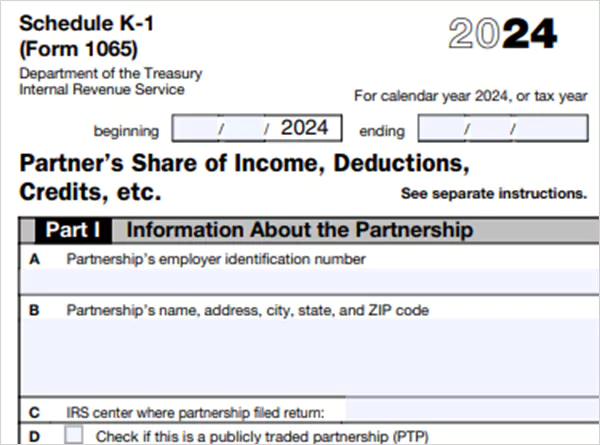
Schedule K-1 Form 1065 consists of three parts, where you should update information related to your income and losses. Here are the steps for filing the business partnership Form 1065.
Step 1: In Part I, you must add information about the partnership, including the name, address, city, state, Employer Identification Number (EIN), and ZIP code.
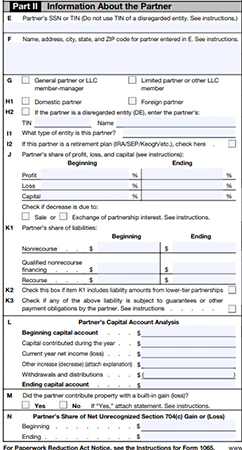
Step 2: In Part II, you must include details of the partner, such as Social Security Number (SSN), Taxpayer Identification Number (TIN), and Employer Identification Number (EIN). Additionally, add information about the type of partner, name, address, liabilities, and capital account.
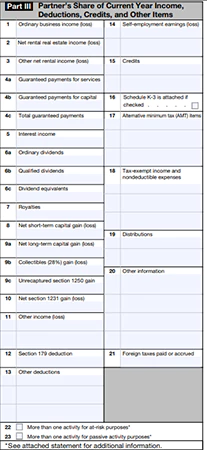
Step 3: In Part III, update the partner’s share of the current year’s income deductions, credits, and other items. The information includes ordinary business income, interest income, dividends, collectibles, and much more.
For S Corporations (Form 1120-S)
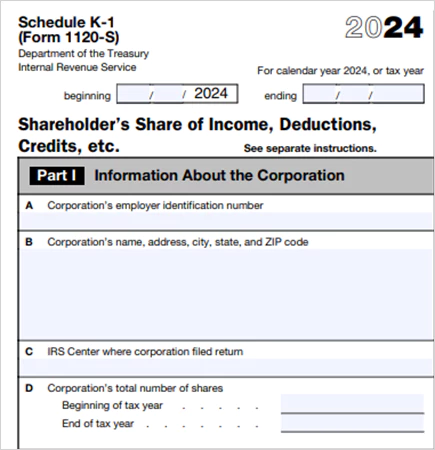
Schedule K-1 Form 1120s include three parts similar to Form 1065. Here, you have to add details about the income, deductions, and credits of the shareholder. Here are the steps for applying for the S corporation Form 1120-S.
Step 1: In Part I, you should add information about the corporation, such as EIN, business name, address, IRS center, and total number of shares for the beginning and ending tax year.
Step 2: In Part II, you must update information about shareholders, including the shareholder’s identification number, name, address, city, state, type of entity, allocation percentage, loans, and number of shares.
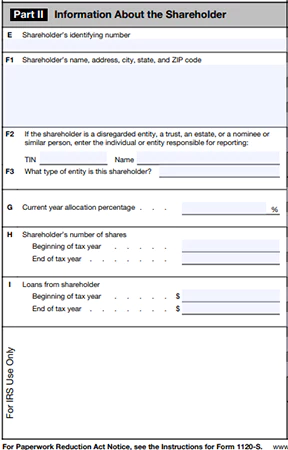
Step 3: In Part III, you can add the shareholder’s share of the current year’s income, deductions, credits, and other items. For example, ordinary business income, net rental estate income, dividends, capital gain, collectibles, credits, and other deductions.

For Trusts and Estates (Form 1041)
Similar to business partnerships and S corporations, Form 1041 also includes three parts, which include details related to beneficiary income and losses. Here are the steps to file Schedule K-1 (Form 1041).
Step 1: In Part I, you should update information about the estate or trust. For example, the identification number, the trust’s name, and the fiduciary’s name, address, city, state, and ZIP code.
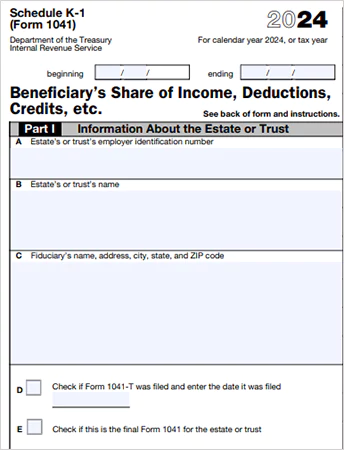
Step 2: In Part II, update information about the beneficiary, such as identifying number, name, address, city, state, ZIP code, and whether you are a domestic or foreign beneficiary.

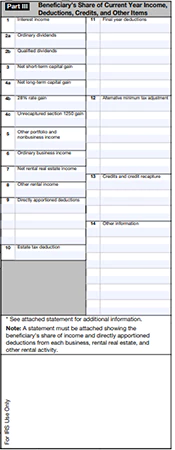
Step 3: In Part III, the beneficiary’s share of the current year’s income, deductions, credits, and other items should be added in the Schedule K-1 Form 1040. For example, interest income, ordinary dividends, capital gains, 28% rate gains, business income, real estate income, credits, and final year deductions.
Also Read: What is a Bonus Tax Rate? How Are Bonuses Taxed and Tips to Reduce Bonus Tax Rate
When are K-1 Forms Due?
Typically, the Schedule K-1 tax form is due on the fifteenth day of the third month of the year, i.e., 15th March. However, it depends on the fiscal year your entity or corporation used for filing taxes.
In some scenarios, the entity follows a different fiscal year schedule; then the deadline to issue Form K1 will be the third month after the end of the year. For example, if a company’s ending fiscal date is January 31st, the K1 form will be due on April 15th.
On the other hand, many entities request a six-month extension if they think they will miss the deadline. The extension period will be scheduled on September 15 for the entities that follow the calendar year. Meanwhile, for the company that uses another fiscal schedule, the extension time is the 15th day of the ninth month after the close of the tax year.
Furthermore, you can look at the breakdown table for a quick overview.
| Company’s Fiscal Year | Condition | Due Date |
| Calendar year | – | March 15 |
| Calendar year | Request for extension period | September 15 |
| Different fiscal year | – | 15th day of the third month after the end of the year. |
| Different fiscal year | Request for extension period | 15th day of the ninth month after the end of the year. |
Also Read: Debt Financing: The Complete Guide to Follow to Secure the Loan
Final Thoughts
That’s the detailed guidance about “What is a K1 tax form?”
The Schedule K1 is a federal tax form that passes through business partnerships, S corporations, trusts, and estates. Afterward, this information is used by shareholders, partners, or beneficiaries to file a personal income tax return (Form 1040). For businesses, combining payroll accounting services and bookkeeping services ensures compliance, reduces errors, and simplifies financial administration.
However, you can also opt for outsourced accounting if you find managing and recording financial administration a juggling task. This helps you to evaluate income, losses, and deductions accurately.
Frequently Asked Questions
Ans: A K1 tax form records all income, credits, and deductions of a shareholder or partner from a pass-through entity.
Ans: An individual who has an ownership interest in business partnerships, S corporations, trusts, or estates receives a Schedule K-1 tax form.
Ans: If you don’t report your K1 form, you won’t be able to file your tax return. As long as you wait, you are obliged to pay penalties to the IRS.
Ans: In pass-through entities, income should transfer to the beneficiaries. In these cases, a K-1 Form is received by individuals. It shows the income they file on tax returns.
Ans: Whether K1 form income is considered earned or unearned income depends on your role in the entity.
- If you are an active owner or general partner, it is considered earned income.
- If you are a limited partner or a beneficiary, it is generally considered unearned income.
Sources: