Mastering Financial Technology: Skills for Tomorrow’s Workforce


AI and automation are transforming every industry. People are expected to have foundational knowledge, along with how AI can be integrated into their workflow to speed things up for better output.
FinTech has tech right there in the name itself, so it is bound to adapt to technological changes faster than other industries.
The demand for an upskilled workforce in FinTech is going to increase. The Future of Jobs Report 2025 found that 63% of employers cite the skills gap as the most significant barrier to business transformation, and 40% of job skills are set to change.
So, if you miss the FinTech upskill bus, you might lag even behind the average employee. But if you take the earliest one, there’s a massive opportunity for you.
To future-proof your finance career, learning tech is not about keeping you ahead of the curve anymore. It just takes you to the baseline now.
What does it take to master financial technology? In this article, I’ll answer exactly that. You’ll get to know why you even should care about FinTech upskilling. The following section lists the top skills to learn, how you can get started, and what the future holds.
KEY TAKEAWAYS
- AI is transforming the FinTech industry just like every other industry.
- Employers are only hiring the top-skilled and also paying them handsomely.
- The hottest skills in FinTech are AI/ML, blockchain, and data analysis.
- Take online courses and certifications in these to stay relevant in the industry.
Why You Need To Learn Fintech Skills Right Now
So, why do you suddenly need to learn new skills for your FinTech career?
The reality is… the finance industry looks different from how it did just a few years ago. Technology has revolutionized how we approach everything from payments to lending, risk management, compliance, and more. And change isn’t slowing down anytime soon.
So how does this impact your career prospects?
Employers are struggling to find skilled workers. A Robert Half survey discovered 93% of hiring managers in financial services have difficulty finding skilled talent to fill open positions. When more jobs are available than qualified people to fill them… you better believe those who can… will.
Professionals who specialize in both finance and technology? They will be scooping up the best roles with top-tier salaries and climbing the ladder quicker than their peers.
Simple supply and demand. When nearly every employer is begging for qualified candidates… the ones who show up qualified will thrive.
The 5 Most Important Skills To Learn
There are hordes of skills to learn in the market. Which one to choose to have the highest career security and growth?
Here are five must-have skills for any modern finance professional…
Data Analysis & Visualisation
You can say goodbye to spreadsheets. Finance has gone digital, and every dollar spent or earned is now tied to data. Being able to analyze that data and visualize your findings is critical. Programming languages like Python and SQL are table stakes. Knowing how to use applications like Tableau is just as important as understanding financial statements.
The moral of the story? Finance professionals who can extract meaningful conclusions from data are heavily sought after.
AI & Machine Learning Fluency
This doesn’t mean every finance professional should become an ML engineer. But understanding the mechanics of AI and how it can be applied to finance is extremely valuable.
Machine learning and AI are being used everywhere. From fraud prevention to algorithmic trading to credit scoring. Automation through AI is the new normal. You can bet employers will continue to seek professionals with experience in AI and machine learning.
The World Economic Forum actually ranks “artificial intelligence and big data skills” among the fastest-growing skills needed by professionals through 2030.
Blockchain/Digital Payments
Don’t worry, this doesn’t mean you need to become a crypto expert. Blockchain tech is used for more than crypto. It’s being used to transform everything from digital payments to supply chain financing.
Understanding how blockchain works and how payments move in the digital age is a serious advantage.
Cybersecurity
Go ahead and add cybersecurity awareness to the list. As more finance functions move online, so does the risk of cyber threats. Professionals who understand cybersecurity risks and how to prevent them are valuable assets.
This doesn’t mean you need to be a cybersecurity expert. But knowing the basics going forward is table stakes.
Regulatory Technology
Regulation. It’s not the most exciting topic, but somebody has to take ethics and regulation while doing what they are doing. Thankfully, there are now fintech tools to automate a lot of the manual processes.
Be it software to automate anti-money laundering checks or systems to monitor transactions in real-time. There are fintech tools for just about every regulatory need.
Understanding how they work and what you need to comply with… Now that is a skill employers are searching for.
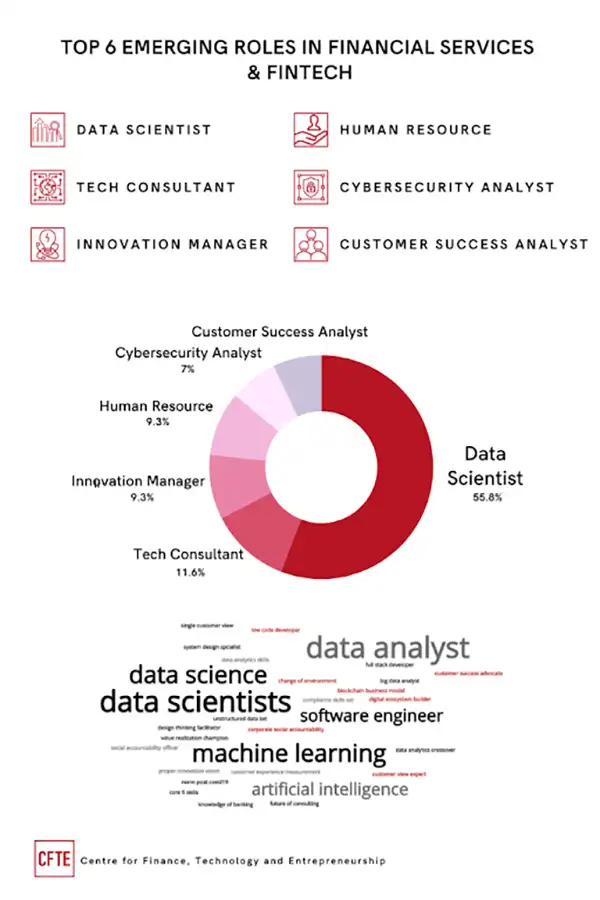
The following infographic shows that the emerging roles in FinTech are around these skills only.
How You Can Start Learning These Skills
It’s been decades since you studied and learned, right?
Don’t fret. You don’t need to return to university to graduate with another degree. While a degree or background in tech can help, there are tons of resources to get you started today.
- Take an online course. Go to Coursera or edX, whatever you fancy. There are plenty of quality fintech courses you can take from universities and colleges around the world. Some courses are even free to audit.
- Become certified. Certifications like the Certified Financial Technologist from the CFA Institute or Google’s Data Analytics Certificates are great for building skills and look great on resumes.
- Practice. Learn by doing. There are financial datasets everywhere on the internet. Learn how to work with real tools. Build your own portfolio of work to showcase what you know.
- Stay Up-To-Date. Follow financial technology news and reports. The landscape changes rapidly, and staying on top of new technology is critical.
Start where you can and build on your skills. FinTech is vast, and you do not need to know everything overnight. Even spending an hour a day can make a big difference over weeks and months.
How Fintech Skills Will Shape The Future Of Finance Careers
With the pace at which technology is evolving, the world might be unrecognizable in the future. So, why do you think that your finance career will stay the same?
Much of that change in this industry will be dictated by who steps up to learn new skills.
Let’s take a look at what the future of finance careers looks like…
The US Bureau of Labor Statistics projects there will be just under 942,500 annual job openings for business and financial occupations through 2034. Fintech careers account for a big chunk of that, as the global fintech market is expected to surpass $1 trillion USD by 2033.
That is a lot of room for growth.
What most people don’t realize is that the professionals who will benefit the most aren’t the ones with 100% tech degrees. Instead, they will be professionals who understand the fundamentals of finance and have practical technology skills.
Picture a hiring manager sifting through resumes. On one side of the desk is a professional who understands finance. On the other side is someone who understands finance and can leverage AI technology and understand data.
I think the answer is pretty obvious as to whom he would choose to recruit.
Conclusion
If you were busy in your cozy finance job, you might have missed how much the industry and its hiring strategy have changed in just the last few years. Employers are desperate to hire skilled professionals but are struggling to find qualified candidates. Professionals who take the time to cultivate fintech skills will be at the front of the line when it’s time to hire. And it’s just going to get more intense.
To sum everything up…
- Emerging technology is revolutionizing the finance industry.
- Employers can’t find qualified candidates with the right skills.
- Data analytics, AI understanding, blockchain, and cybersecurity are some of the top skills you need to know.
- There are tons of resources available for you to start learning these skills today.
- Finance career prospects are incredibly bright for professionals who specialize in fintech.
The future of finance will accommodate only those who prepare for it today. The demand is there. Now is the time to start building your skills.
Ans: Financial analysts need to focus on honing their analysis, forecasting, and communication skills.
Ans: The future revolves around three things: AI-powered personalization, decentralized finance (DeFi), and embedded finance.
Ans: The top 5 emerging FinTech technologies are AI/ML, blockchain, cloud, RPA (robotic process automation), and embedded finance.