What is 403b Plan? Find its Pros and Cons, and How Does It Work?

IRS offers a wide range of retirement plans, including one special plan, “403(b)”, that is eligible for non-profit and government employees. Now, you may wonder, “What is 403b plan?” and how it benefits you.
If you are a worker at a non-profit organization, you are allowed to save money systematically to enjoy your retirement. To acknowledge the 403(b) benefits, let’s dig deeper into this article to uncover contribution limits, advantages, disadvantages, the difference between 401(k) and 403(b), and some investment tips. Proper retirement planning works best when supported by strong financial systems like cash flow management services that ensure long-term financial stability.
- What is 403b?
- How Does 403(b) Work?
- What are the 403b Employee Contribution Limits?
- Advantages of 403(b)
- Disadvantages of 403(b)
- 403(b) Withdrawal Rules
- Difference Between 401k and 403b
- How to Choose an Investment in Your 403(b)?
- How Much Should You Contribute to a 403(b)?
- Wrapping Up!
- Frequently Asked Questions
What is 403b?
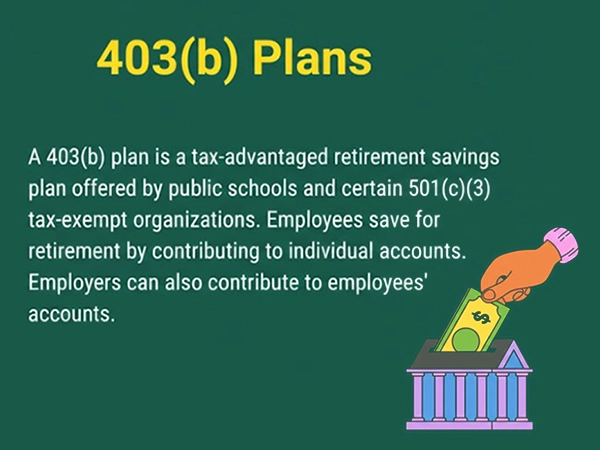
A 403(b), also known as a tax-sheltered annuity or TSA plan, is a type of retirement plan that is only available and accessible to employees of public schools and non-profit organizations, such as teachers, nurses, doctors, government workers, and librarians.
Employees save for retirement by contributing to individual accounts. It means that some amount is deducted from employees’ salaries and automatically transferred to the 403(b) retirement plan, similar to structured payroll deductions handled through professional payroll accounting services.
It is estimated that the 403(b) plan covers 90% of US employees. Therefore, as a non-profit employee, you can use this retirement plan to maintain your desired living standard when you get older while maintaining disciplined financial tracking through reliable bookkeeping services.
How Does 403(b) Work?
According to the IRS (Internal Revenue Service), “A 403(b) retirement plan lets employees defer some of their salary into individual accounts. The deferred salary is not subject to federal or state income tax until it’s distributed.”
Moreover, contributions to a 403(b) plan are tax-deductible, which means earnings are tax-free until you make a withdrawal. Vice versa, it can also be set up like a Roth retirement savings plan, meaning contributions are taxable and withdrawals are tax-free. Managing such tax-deferred income properly often requires professional financial oversight similar to year-end accounts services.
Eligible employers who offer and manage the plan are:
- Public school, college, or university
- Church
- Charitable entity tax-exempt under Section 501(c)(3) of the Internal Revenue Code
It is important to note that the contribution amount will differ from employee to employee. Employers offer contributions that match your vesting schedule, which determines the dollar amount and interest paid to you when you separate from service. This indicates that you own your contributions and associated earnings.
For example, if your employer offers a 10% match, they will deduct 10% of the amount from your paycheck or salary. Interestingly, you can also choose the match, and if you select 4%, the 4% amount will be deferred from your salary.
After acquiring knowledge on what is 403b and how does it work, let’s skim through the next section to understand employee contribution limits.
Also Read: Remittance Tax Explained: Meaning, US Rules, Rates, and Exemptions
What are the 403b Employee Contribution Limits?
In 2026, the 403b employee contribution limits are $24,500 per year for those below age 50. In addition, those who are 50 to 59, 64, or older will be eligible to contribute up to an additional $8,000. It means you (+50) will be allowed to catch up and contribute a total of $32,500 in 2026.
In case you are 60-63, you are eligible for super catch-up with contributions of up to $11,250. Interestingly, if you have at least 15 years of service with the same eligible employer, you’re qualified for an elective deferral limit as high as $15,000.
These limits are applied based on the employee’s annual income, cash flow, and maximum contributions to both a 403(b) and a 457(b) plan if eligible. Maintaining accurate records of such contributions becomes easier with organized financial tracking.
Attention High Earners: If you are a 50+ employee and earned more than $150,000 in FICA wages in 2025, your 2026 403(b) contributions must be made to a Roth account.
Advantages of 403(b)
403(b) offers advantages, including automatic transfer, employer contributions, compounding returns, and a 15-year service catch-up.
Let’s take a look at the following benefits of 403(b) retirement plans.
1. Automatic Transfer
It is obvious that saving money for retirement is quite a juggling task because it includes choosing the right investment, an individual account, and an accurate payroll. That’s why contributing to 403(b) is a trustworthy and quick decision.
It automatically transfers the amount to the retirement account when you receive a paycheck.
2. Employer Contributions
As an employee benefit, some organizations offer an employer match that contributes to your 403(b) retirement plan. These employer contributions enhance long-term savings. For example, an employer could contribute $1 to your $1 or $1 to your $2.
A match provides additional funds to your account that can potentially benefit from compounding interest and grow over time.
3. Compounding Returns
Compounding in a 403(b) retirement plan is when your returns earn interest over time, leading to exponential growth. By reinvesting these earnings, a 403(b) account enables a snowball effect, where long-term investments grow significantly more than just principal and contributions.
This indicates that the earlier you start, the longer your funds have to compound, leading to higher profits at the end of the retirement plan.
4. 15 Year Service Catch-Up
If you serve 15 or more years of service with the same employer or organization, you may be able to make additional catch-up contributions to a 403(b) retirement plan. The usual eligibility for this catch-up starts at age 50 and is as high as $15,000.
It signifies that loyal employees may benefit from investing in a 403(b) plan in return for their consistency, loyalty, and dedication.
Disadvantages of 403(b)
Just like a coin has two sides, the 403(b) plan also has disadvantages, like limited choices, early withdrawal charges, and a lack of ERISA protection.
Financial planning decisions, including retirement investments, should be evaluated carefully — similar to the structured financial planning required in accounting services for startups where long-term sustainability matters.
Here, I’ve mentioned the drawbacks of investing in 403(b) funds.
1. Limited Choices
403(b) plans often offer limited investment choices because they are legally bound to annuity contracts and custodial accounts holding mutual funds. These plans typically focus on costly insurance like annuities and leave you suffering from high fees.
2. Early Withdrawal Charges
If you withdraw money from a 403(b) plan before age 59½, you may owe income tax on your earnings in the year you withdraw, plus a 10% tax penalty. This means that withdrawal after age 59½ only offers tax-exempt benefits, and early withdrawals will lead to high charges.
3. Lack of ERISA Protection
Plans without employer matching do not include Employee Retirement Income Security Act protections, which means few minimum standards and protections for participants.
After all, it is advised to consider both advantages and disadvantages to understand what is 403b deeply and properly.
403(b) Withdrawal Rules
The IRS set some strict guidelines regarding withdrawal from 403(b) accounts. Let’s take a look at these pointers before investing in these retirement funds.
1. You can make a penalty-free withdrawal once you reach 59½ years old and are not subject to the 10% penalty tax.
2. You may be able to withdraw a balance earlier from your account if your 403(b) plan allows. However, you have to keep in mind that:
- Still, you have to pay yourself back, including interest.
- If you take money from your retirement account at any time, you will miss out on the benefits of compound returns, making a shortage of your retirement amount.
- Moreover, in case your employment situation changes, you will have to repay it by the time you file taxes for the year you lost your job or left a job. If you can’t repay the loan, it is considered an early withdrawal by the IRS and imposes a 10% penalty and other income taxes.
3. You can take up to $1,000 per year for certain personal emergencies or expenses. This withdrawal is subject to plan rules and is exempt from penalties.
Difference Between 401k and 403b
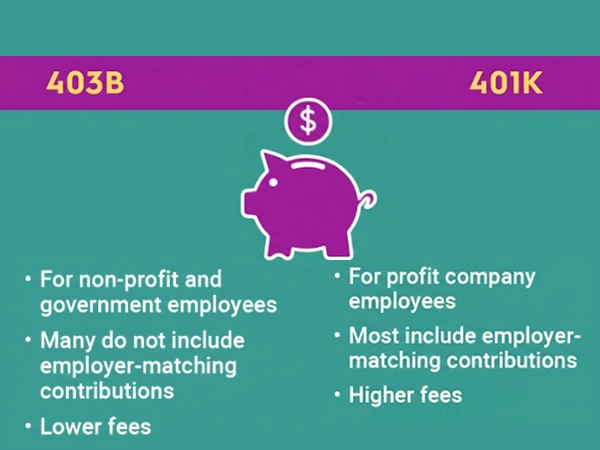
While both are IRS retirement plans, the 401(k) plan is for profit and private-sector employees, while the 403(b) is for non-profit, government, and public workers.
Here is the breakdown table of the difference between 401(k) and 403(b) plans.
| Feature | 401(k) | 403(b) |
| Eligible Employer | It is eligible for profit and private-sector companies. | It is eligible for non-profit, government organizations, public employees, and churches. |
| Purpose | A retirement plan for employees to save enough money for their living without tax liability. | Same as a 401(k) plan, designed to encourage long-term and systematic savings through payroll deductions. |
| Primary Investments | Mutual funds, ETFs, stocks, and bonds. | Only focus on annuities and mutual funds. |
| 2026 Contribution Limits | $24,500 | $24,500 |
| Age 50+ Catch Up Benefits (2026) | $8,000 annually | $8,000 annually |
| Age 60-63 Catch Up (2026) | Upto $11,250 (if plan allows) | Upto $11,250 (if plan allows) |
| 15-Year Service Catch-Up | No | Yes, upto $15,000 lifetime contributions are allowed. |
| Early Withdrawal Fees | 10% penalty charges with other applicable income taxes. | 10% penalty charges with other applicable income taxes. |
| ERISA Protection | Yes (Federal protection) | Limited to when an employer offers a match to an employee. |
| Fees and Costs | Depends on a plan, generally high. | Lower, but annuity fees can be high. |
How to Choose an Investment in Your 403(b)?
After understanding what is 403b plan, choosing the right investment plan is more significant, which involves low-cost, diversified options that align with your risk tolerance and retirement timeline.
For this reason, it’s important to be aware of how much you are paying for the investment. Firstly, you should read the plan prospectus or the contract that outlines costs, investment options, risk tolerance, and performance history.
Secondly, you should be able to discuss the 403(b) plan with professionals or your employer’s Human Resources department. It helps you to gain essential knowledge about plans and provide clarification.
After that, when it comes to selecting funds, a good option is investing in stock funds through mutual funds or annuities. It is suitable when you have many years before retirement because stock returns have been historically higher than fixed investments. However, you may opt for fixed income returns when you have a short retirement time period.
Overall, selecting the fund option is your personal decision that aligns with your financial preferences.
Also Read: What is a CD Account? How Do CDs Work and How to Open Them?
How Much Should You Contribute to a 403(b)?
Experts recommend contributing between 10% and 15% of your salary to your 403(b) account and starting as early as possible. It is the perfect evaluation to ensure a comfortable retirement at a minimum.
You should calculate how much you want to save for your retirement based on your annual salary, contribution rate, age, expected return, employer match (if applicable), and other factors. The accurate calculations and right investment funds help you to save money systematically for your retirement, fulfilling your financial needs even after getting older.
Wrapping Up!
To sum up, 403(b) is a retirement plan for non-profit employees that saves money through payroll deductions without imposing income tax. You are only allowed to take money after 59½ years old, and early withdrawals will lead to a 10% penalty.
After acquiring knowledge on “What is 403b plan?”, you can enjoy a comfortable retirement. You should start as early as possible. Also, it is advised that you take some financial suggestions from your employer’s Human Resource Department and financial experts before choosing your 403(b) funds.
Frequently Asked Questions
Ans: A 403(b) is a type of IRS retirement plan for non-profit employees and public school workers, allowing them to save money for retirement. Eligible employers defer some amount of money from an employee’s paycheck annually and contribute it to a 403(b) account.
Ans: There are some disadvantages of a 403(b) plan, such as:
- Early withdrawal penalties
- Limited choices for employees
- Lack of ERISA protection
- High maintenance fees
Ans: The major difference between 401(k) and 403(b) is:
401(k) is eligible for profit and private sector companies, while 403(b) is for non-profit and government employees.
Ans: You can generally withdraw money from your 403(b) account when you reach 59½, without 10% penalty and other income taxes.
Sources: